
WanderStay: Simplifying Global Relocation
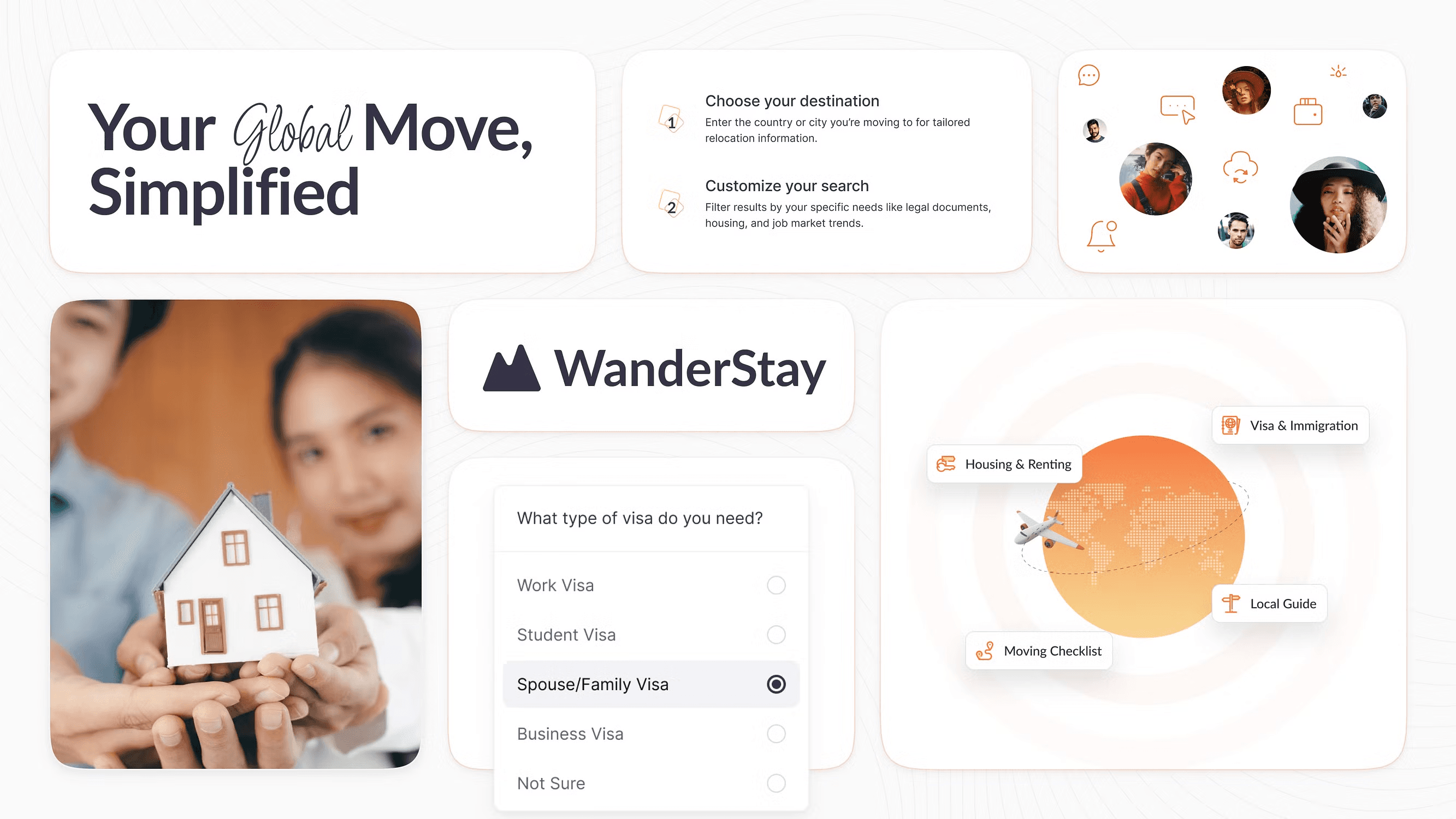
Relocation is often described as an exciting new chapter, but for many professionals moving to Europe, it quickly turns into an "information nightmare". WanderStay is a digital platform designed to solve this by acting as a centralized "single source of truth" for relocation.
The initiative was sparked by a direct struggle within our own team: a teammate attempting to move within Europe found the web to be a "confusing maze," leading to the realization that there "gotta be a simpler way" to find everything in one place. As a UX Researcher, I led the qualitative inquiry to expand on this personal insight, uncovering the specific anxieties and logistical friction points faced by expats to ensure our solution was emotionally reassuring.
Role
UX Researcher
Project Duration
May - Jun 2024
Industry
Relocation
Market Opportunity
$26.8 billion (2030)
Organization
Hackathon with TechLeap
Challenge
The WanderStay project addressed a dual crisis: the Systemic Failure of Relocation Information for top talent moving to Europe (the External Problem) and the Aggressive 4-Week Deadline (the Internal Constraint) imposed on the solution team.
1. The External Problem: The "Information Nightmare"
The fundamental challenge for the user was the fragmentation and unreliability of information surrounding global relocation, creating immense anxiety and wasted time.
Information Fragmentation: Legal documents, visa requirements, housing markets, and local guides were scattered across a "confusing maze" of disparate websites, meaning no single, reliable source of truth existed.
Trust and Reliability Gap: Users faced a high-stakes, stressful experience due to constant worry that the information they found was outdated, incorrect, or not applicable to their specific visa or country of origin.
Cognitive Overload: The inherent complexity of managing timelines, legal hurdles, and document gathering turned the exciting prospect of moving into an overwhelming, chaotic process.
2. The Internal Constraint: The 4-Week Delivery Cycle
The solution team had to tackle this systemic user crisis under the extreme pressure of an aggressive four-week deadline, which created an internal constraint on research and design processes:
Time Pressure: The project required an immense amount of work across all stages—MVP definition, user research, prototyping, and testing—in a highly compressed timeline.
Rapid Prioritization: This demanded the team to rapidly prioritize features to define a robust Minimum Viable Product (MVP).
Seamless Iteration: The team had to conduct foundational user research sufficient to validate the core concept and move seamlessly from research insights to high-fidelity prototyping and back to testing without delay.
Results
The project's outcome was a successful, complete product package delivered under extraordinary time pressure:
Full Delivery: The team successfully developed and finalized the MVP, prototype, and testing documentation within the strict four-week deadline.
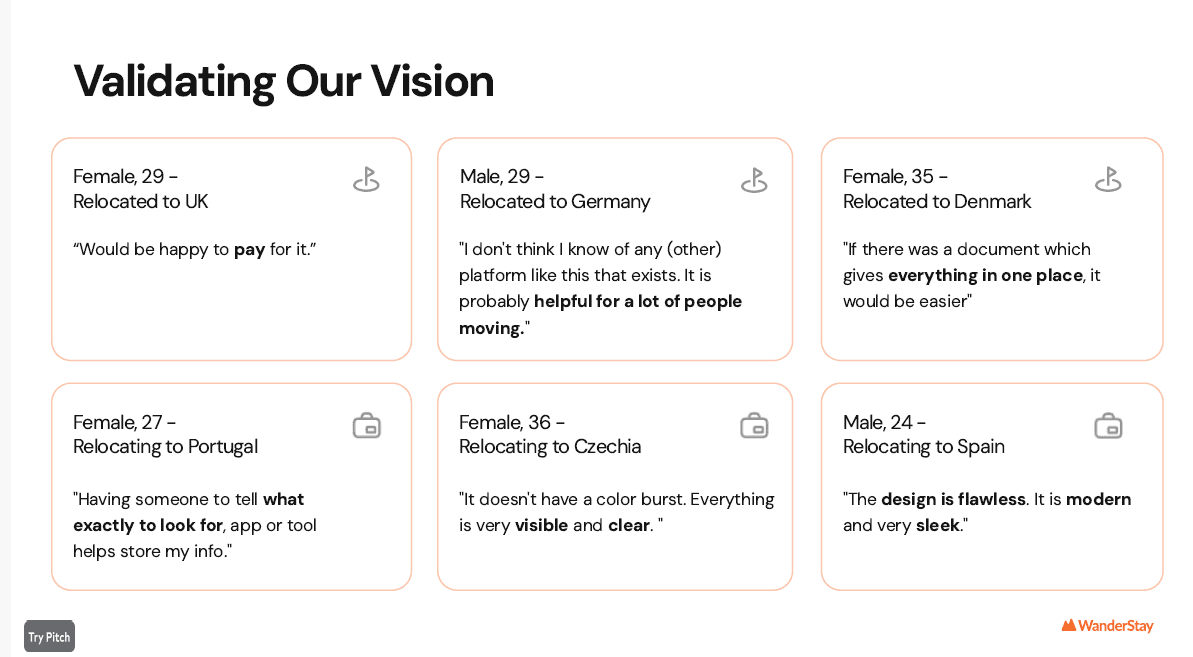
Validation: The intensive four-round research process provided timely validation for the core product concept and feature set.
Process
The research and development process was exceptionally accelerated, requiring an agile and efficient multi-method approach compressed into four weeks:
Aggressive Iteration: The project utilized a total of four distinct rounds of user research to quickly build and validate the product.
Methodology Mix: This intensive research schedule included an initial survey to gather broad quantitative input and three subsequent rounds of qualitative interviews to drill down into specific user needs and test prototypes.
Leadership & Execution: I played a critical leadership role in driving the research pipeline, personally conducting and leading 70% of the user interviews. This ensured rapid access to high-quality insights necessary for immediate design decisions.
Conclusion
The successful delivery of the Wanderstay project proved the team’s ability to execute a complete product development cycle—from research inception to tested MVP—in a highly compressed timeframe. This project validated that high-quality, actionable results can be achieved by employing an aggressive, iterative research strategy.